

If you have ever sat in the dental chair and wondered, “Do I really need X-rays again?” you are not alone. Many patients ask this question, especially if their teeth feel fine, they had X-rays recently, or they are trying to keep their appointment as simple as possible.
Dental X-rays are an important diagnostic tool, but that does not always mean every patient needs them at every single visit. The right timing depends on your oral health, symptoms, dental history, risk level, and the type of appointment you are having.
For patients in Medical Lake, Airway Heights, Cheney, Fairchild Air Force Base, and surrounding Spokane County communities, understanding why dental X-rays are recommended can help you feel more informed and confident during your visit.
At Medical Lake Family Dental, dental care is focused on helping patients understand their oral health clearly, make confident decisions, and receive care that fits their needs.
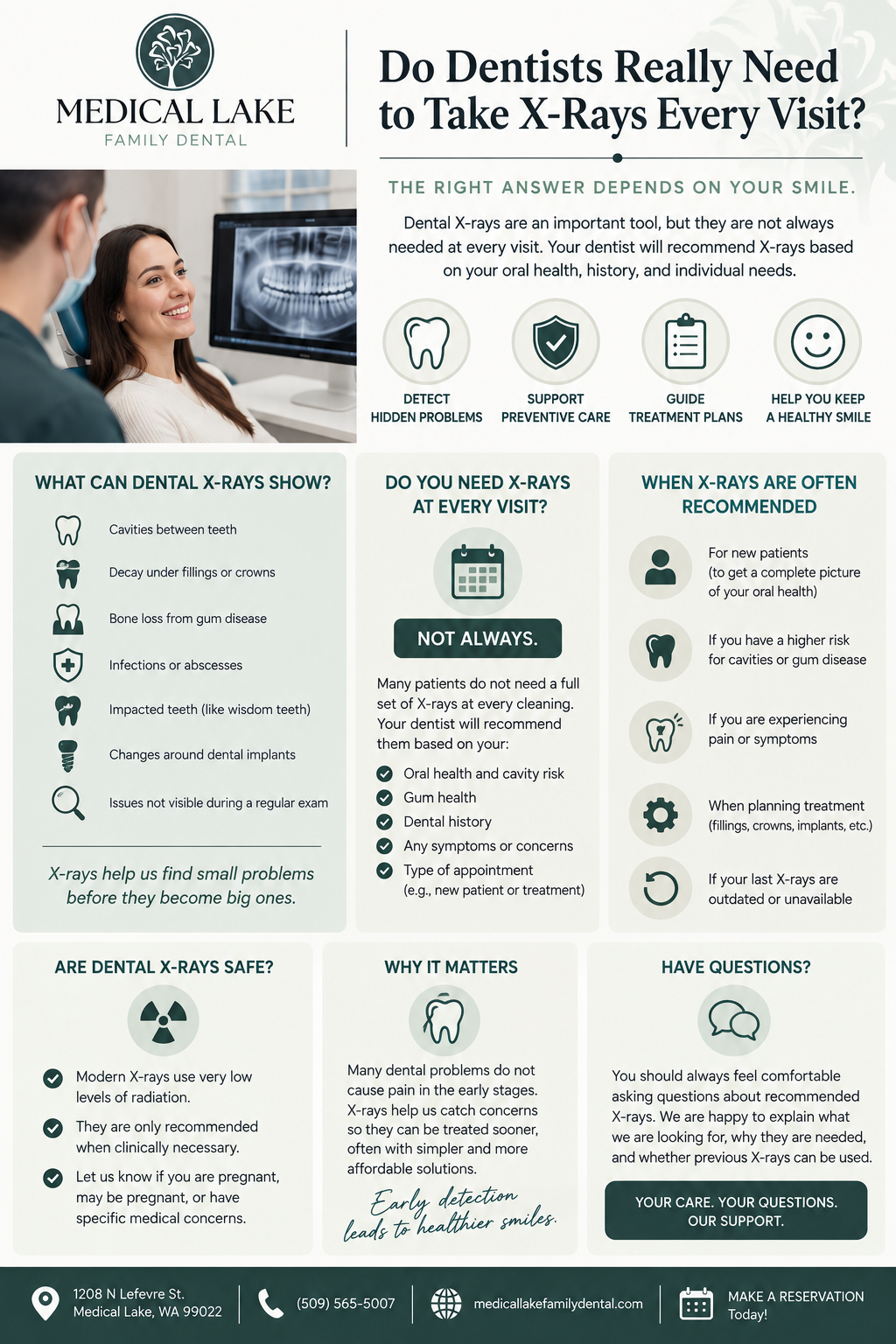
Why Do Dentists Take X-Rays?
Dental X-rays help your dentist see areas of your mouth that are not always visible during a regular exam. Even with a careful visual check, some problems can develop between teeth, under old dental work, below the gumline, or around the roots of teeth.
X-rays may help your dentist identify cavities between teeth, decay under fillings or crowns, bone loss from gum disease, infections, abscesses, impacted teeth, root concerns, jawbone changes, and issues related to past dental work.
Without X-rays, some dental problems may go unnoticed until they become painful or more difficult to treat.
Do You Need Dental X-Rays at Every Visit?
Not always. Many patients do not need a full set of X-rays at every routine cleaning. However, your dentist may recommend X-rays based on what they are monitoring and what has changed since your last visit.
Some patients may need X-rays more often because they are at higher risk for cavities, gum disease, infection, or complications from existing dental work. Others may need them less frequently because their oral health is stable and they are not experiencing symptoms.
Your dentist should be able to explain why X-rays are being recommended and what information they are looking for.
Why X-Rays May Be Recommended for New Patients
If you are visiting a new dental office for the first time, X-rays may be recommended to help establish a complete picture of your oral health. This is especially helpful if your previous dental records are unavailable, outdated, or do not show the areas your new dentist needs to evaluate.
A first visit may include a comprehensive exam, review of your health history, evaluation of your teeth and gums, and diagnostic imaging when needed. This helps your dentist identify current concerns, monitor existing dental work, and create a treatment plan that fits your needs.
For new guests, Medical Lake Family Dental focuses on helping patients feel comfortable, informed, and supported from the start. You can learn more about preparing for your first appointment on their New Dental Guests page.
Why Waiting Until It Hurts Can Be Risky
Many dental problems do not cause pain in the early stages. A small cavity, early infection, gum disease concern, or issue under existing dental work may be developing before you feel anything unusual.
By the time pain appears, treatment may be more involved. A small cavity may only need a filling, while deeper decay could require a crown, root canal, or other restorative care. This is one reason X-rays can be helpful as part of preventive dentistry.
If you are already experiencing tooth pain, swelling, a broken tooth, or sudden sensitivity, Medical Lake Family Dental offers Emergency Dentistry for patients who need prompt dental care.
How Often Should Dental X-Rays Be Taken?
There is no single schedule that fits every patient. Your dentist will recommend X-rays based on your individual needs.
The timing may depend on:
Your age
Your cavity risk
Your gum health
Your dental history
Existing fillings, crowns, bridges, implants, or dentures
Whether you are having pain or symptoms
When your last X-rays were taken
Whether you are a new or returning patient
Whether treatment is being planned
Your medical history
A patient with a history of frequent cavities may need X-rays more often than a patient with very low cavity risk. A patient with gum disease may need imaging to monitor bone levels. A patient with a dental emergency may need an X-ray right away to find the source of pain.
What If You Recently Had X-Rays Somewhere Else?
If you recently had dental X-rays taken at another office, let your new dental team know. In some cases, those records may be transferred and reviewed instead of taking new images.
However, new X-rays may still be needed if the previous images are outdated, unclear, incomplete, or do not show the area of concern. New images may also be recommended if you have new symptoms, are planning treatment, or your oral health has changed since the last images were taken.
It is always worth asking whether previous records can be used.
Are Dental X-Rays Safe?
Many patients have questions about radiation exposure. Modern dental X-rays are designed to use a very low amount of radiation, especially compared to older imaging methods. Your dental team should only recommend X-rays when they are clinically helpful and relevant to your care.
If you are pregnant, may be pregnant, have had radiation therapy, or have specific medical concerns, let your dentist know before X-rays are taken. Your health history helps your dental team make the safest recommendations for your situation.
Why Your Medical History Still Matters
Your medical history helps your dentist understand your overall health and any precautions that may be needed. While most patients can safely receive routine dental imaging, it is still important to share relevant health updates.
Tell your dental team if you are pregnant or may be pregnant, have had radiation treatment, started new medications, had recent surgery, received a new diagnosis, or are experiencing new symptoms.
A complete health history allows your dentist to personalize your care and explain the reasoning behind each recommendation.
Can You Say No to Dental X-Rays?
Patients should always feel comfortable asking questions about recommended care. If you are unsure about dental X-rays, ask your dentist why they are needed, what they are checking for, and whether the timing is necessary.
Helpful questions include:
Why are X-rays being recommended today?
What are you looking for?
When were my last X-rays taken?
Can previous X-rays be used?
Is this a routine image or related to a specific concern?
What happens if we wait?
In some situations, delaying X-rays may be reasonable. In others, your dentist may explain that imaging is necessary to diagnose a problem properly or provide safe treatment.
The goal is not to pressure you. The goal is to help you make an informed decision.
How X-Rays Support Preventive Dental Care
Preventive care is about finding and addressing concerns early. Dental cleanings and exams help remove buildup, monitor gum health, check for cavities, and identify changes in your mouth. X-rays can add another layer of information when needed.
By combining a professional cleaning, dental exam, gum evaluation, oral health discussion, and diagnostic imaging when appropriate, your dental team can give you a clearer understanding of your smile.
You can learn more about routine preventive visits through Medical Lake Family Dental’s Cleaning and Prevention page.
X-Rays and Treatment Planning
Dental X-rays are also important when planning treatment. If you need a filling, crown, root canal, extraction, implant, denture, or other dental procedure, your dentist may need imaging to understand the condition of the tooth, root, bone, and surrounding structures.
Good treatment planning depends on good information. X-rays can help your dentist determine how advanced a concern is, whether infection is present, and which treatment options are most appropriate.
Medical Lake Family Dental provides a full range of dental services, including preventive, cosmetic, restorative, and specialized care for patients at different stages of life.
Choosing a Dentist Who Explains Your Care
One of the best ways to feel confident at the dentist is to choose a dental team that explains what they are doing and why. You should feel comfortable asking questions about X-rays, exams, treatment recommendations, cost, timing, and alternatives.
A good dental experience should feel clear, respectful, and personalized.
At Medical Lake Family Dental, patients receive care focused on comfort, confidence, and long-term oral health. Whether you are coming in for a routine cleaning, a first visit, or a specific dental concern, the team is there to help you understand your options and feel supported throughout your care.
Schedule a Dental Visit in Medical Lake, WA
Dental X-rays are not always needed at every visit, but they can be an important part of understanding your oral health. They help your dentist detect hidden cavities, infections, bone loss, damaged dental work, and other concerns that may not be visible during a regular exam.
For patients in Medical Lake, Airway Heights, Cheney, Fairchild Air Force Base, and nearby Spokane County communities, routine dental care can help prevent small problems from becoming bigger issues.
To schedule your next visit, go to the Make an Appointment page and connect with the Medical Lake Family Dental team.
Frequently Asked Questions About Dental X-Rays
-
Not always. Some patients need X-rays more often than others depending on their oral health, symptoms, cavity risk, gum health, and dental history. Your dentist should explain why X-rays are being recommended and what they are checking for.
-
Dental X-rays can show cavities between teeth, decay under old dental work, bone loss, infections, impacted teeth, root problems, jawbone changes, and other concerns that may not be visible during a regular exam.
-
In some cases, yes. If your previous X-rays are recent, clear, and show the areas your dentist needs to evaluate, they may be helpful. New images may still be needed if you have new symptoms, outdated records, or treatment planning needs.
-
Modern dental X-rays use low levels of radiation and are recommended only when they provide helpful diagnostic information. Let your dentist know if you are pregnant, may be pregnant, or have specific medical concerns.
-
Many dental problems do not cause pain in the early stages. X-rays can help detect cavities, bone loss, infections, or issues under existing dental work before they become more serious or painful.
